설명 / Description
스몰 멀티플은 동일한 데이터셋의 서로 다른 슬라이스 — 다른 시간대, 다른 범주, 다른 지역 — 를 보여주는 작고 유사하게 디자인된 차트들이 그리드로 배열된 시리즈입니다. 각 패널의 디자인은 동일합니다: 같은 차트 유형, 같은 축, 같은 스케일, 같은 시각적 인코딩. 오직 데이터만 변합니다. 이 기법을 명명하고 대중화한 에드워드 터프티(Edward Tufte)는 스몰 멀티플을 "다른 데이터를 표시하기 위해 반복되는 동일한 디자인 구조"라고 설명하며 "광범위한 데이터 디스플레이 문제에 대한 최고의 설계 솔루션"이라고 불렀습니다.
스몰 멀티플의 힘은 변하지 않는 것에 있습니다. 차트 구조, 축, 스케일이 패널 간에 동일하기 때문에 시청자의 눈은 그리드를 스캔하는 것만으로 직접적이고 신뢰할 수 있는 비교를 할 수 있습니다. 형태, 높이, 기울기, 밀도의 변화가 시각적 맥락이 안정적이기에 바로 드러납니다. 시청자는 각 패널의 인코딩을 다시 배울 필요가 없습니다 — 첫 패널에서 한 번 배운 후 나머지를 페이지의 단어를 읽듯이 "읽습니다." 이는 4~5개 이상의 시리즈가 되면 복잡하고 읽기 어려워지는 단일 차트에 여러 시리즈를 겹치는 것과 근본적으로 다릅니다.
스몰 멀티플은 또한 우아하게 확장됩니다. 50개의 겹치는 선이 있는 단일 차트는 읽을 수 없습니다. 각각 일관된 배경 위에 하나의 선을 보여주는 50개의 스몰 멀티플은 스캔 가능합니다. 이 기법은 시각적 밀도를 명확성으로 교환합니다: 각 패널은 더 단순하지만 그리드 전체가 완전한 복잡성을 전달합니다. 이 트레이드오프는 거의 항상 가치 있으며, 스몰 멀티플은 범주별 분할(국가별, 제품별, 인구 통계 그룹별 패널), 시간별 분할(연도별 패널), 모델별 분할(시나리오 또는 파라미터 설정별 패널)에 특히 효과적입니다.
Small multiples are a series of small, similarly designed charts arranged in a grid, each showing a different slice of the same dataset — different time periods, different categories, different geographic regions. The design of each panel is identical: the same chart type, the same axes, the same scales, the same visual encoding. Only the data changes. Edward Tufte, who named and popularized the technique, described small multiples as "the same design structure repeated to display different data" and called them "the best design solution for a wide range of problems in data display."
The power of small multiples lies in what stays constant. Because the chart structure, axes, and scales are identical across panels, the viewer's eye can make direct, reliable comparisons simply by scanning across the grid. Changes in shape, height, slope, or density leap out because the visual context is stable. The viewer does not need to re-learn the encoding for each panel — they learn it once from the first panel and then "read" the rest like reading words on a page. This is fundamentally different from overlaying multiple series on a single chart, which becomes cluttered and illegible beyond 4–5 series.
Small multiples also scale gracefully. A single chart with 50 overlapping lines is unreadable. Fifty small multiples, each showing one line against a consistent backdrop, remain scannable. The technique trades visual density for clarity: each panel is simpler, but the grid as a whole conveys the full complexity. This trade-off is almost always worthwhile, and small multiples are particularly effective for faceting by category (one panel per country, per product, per demographic group), by time (one panel per year), or by model (one panel per scenario or parameter setting).
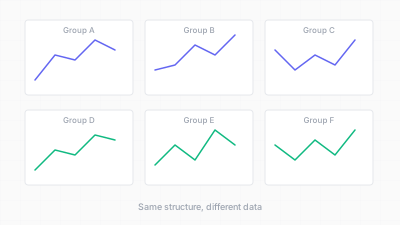
스몰 멀티플: 동일 구조의 반복으로 범주 간 비교를 가능하게 함 / Small multiples: repeated identical structure enabling comparison across categories
핵심 아이디어 / Key Ideas
- 공유 축과 스케일은 타협할 수 없습니다: x축이나 y축이 패널 간에 다르면 비교가 무효화됩니다. 시청자는 일관성을 가정하며 스케일이 다르면 잘못된 결론을 내립니다.
- Shared axes and scales are non-negotiable: if the x-axis or y-axis differs between panels, the comparison is invalid. Viewers assume consistency and will draw false conclusions if scales vary.
- 일관된 시각적 인코딩: 같은 색상, 형태, 선 스타일이 모든 패널에서 같은 것을 의미해야 합니다. 패널 간 인코딩 변경은 목적을 무효화합니다.
- Consistent visual encoding: the same color, shape, and line style must mean the same thing in every panel. Changing encoding between panels defeats the purpose.
- 읽기 순서가 중요합니다: 패널을 논리적 순서로 배열합니다 — 시간순, 알파벳순, 또는 핵심 지표 기준 순위. 의미 있는 순서가 패턴(추세, 주기, 이상치)을 드러냅니다.
- Reading order matters: arrange panels in a logical order — chronological for time, alphabetical for categories, or ranked by a key metric. A meaningful order makes patterns (trends, cycles, outliers) visible.
- 각 패널에 레이블 부착: 일관된 위치에 작고 명확한 레이블(범주명, 연도, 지역)을 배치합니다. 레이블은 데이터보다 부차적이되 즉시 식별 가능해야 합니다.
- Label each panel: a small, clear label (the category name, the year, the region) in a consistent position on each panel. The label should be subordinate to the data but immediately identifiable.
- 패널별 장식 최소화: 구조가 반복되므로 축 레이블과 눈금은 공유할 수 있습니다. 왼쪽 열과 하단 행에만 전체 축 레이블을 표시하고 내부 패널은 데이터 영역만 필요합니다.
- Minimize per-panel decoration: since the structure repeats, axis labels and tick marks can be shared. Show full axis labels only on the leftmost column and bottom row; interior panels need only the data area.
- 사용 시점을 파악합니다: 스몰 멀티플은 범주가 6~50개일 때 빛납니다. 6개 미만은 단일 차트에 겹치는 것이, 50개 이상은 집계나 인터랙티브 필터링이 나을 수 있습니다.
- Know when to use them: small multiples shine when the number of categories is 6–50. Fewer than 6 may work better as overlaid series on one chart; more than 50 may need aggregation or interactive filtering.
좋은 예시 / Good Examples
- 터프티의 갈릴레오 태양 흑점 그림: 스몰 멀티플의 가장 초기 사례 중 하나. 각 패널이 다른 날의 태양을 보여주며 흑점 위치가 다릅니다 — 그리드가 태양의 자전을 드러냅니다.
- Tufte's Galileo sunspot drawings: one of the earliest examples of small multiples. Each panel shows the sun on a different day, with spots in different positions — the grid reveals the sun's rotation.
- 국가별 COVID-19 확진 곡선: 파이낸셜 타임스가 수십 개 국가의 유행 곡선을 보여주는 스몰 멀티플 꺾은선 그래프를 대중화했습니다. 데이터만 다른 동일한 패널로 어떤 국가가 일찍 정점을 찍었는지, 여러 차례 파도가 있었는지, 커브를 평탄화했는지 즉시 식별할 수 있었습니다.
- Per-country COVID-19 case curves: the Financial Times popularized small multiple line charts showing epidemic curves for dozens of countries, each panel identical except for the data. Viewers could instantly identify which countries peaked early, which had multiple waves, and which flattened the curve.
- 산점도 행렬(SPLOMs): 모든 변수 쌍이 그리드의 산점도로 표시됩니다. 일관된 구조가 여러 차원에서 상관관계를 스캔할 수 있게 합니다.
- Scatterplot matrices (SPLOMs): every pair of variables is shown as a scatterplot in a grid. The consistent structure lets viewers scan for correlations across many dimensions.
- 제품 범주별 월간 매출: 12개 패널(월별 하나), 각각 범주별 매출 막대 차트. 그리드를 스캔하면 계절 패턴이 즉시 드러납니다.
- Monthly sales by product category: twelve panels (one per month), each showing a bar chart of sales by category. Seasonal patterns become immediately visible by scanning across the grid.
안티 패턴 / Anti-Patterns
- 패널별 다른 y축 스케일: 가장 흔하고 가장 해로운 실수. 한 패널의 y축이 0~100이고 다른 패널이 0~10,000이면 두 패널에서 같은 높이의 막대가 100배 다른 값을 나타냅니다.
- Different y-axis scales per panel: the most common and most damaging mistake. If one panel's y-axis runs 0–100 and another runs 0–10,000, a bar that looks the same height in both panels represents values that differ by 100x.
- 기법에 비해 너무 적은 패널: 나란한 두 차트는 비교이지 스몰 멀티플이 아닙니다. 이 기법의 힘은 그리드 구조로 패턴 탐지가 가능한 6개 이상의 패널에서 나타납니다.
- Too few panels for the technique: two side-by-side charts are a comparison, not small multiples. The technique's power emerges with 6+ panels where the grid structure enables pattern detection.
- 과부하된 패널: 각 스몰 멀티플은 단순해야 합니다 — 최대 1~2개 시리즈. 각 패널에 복잡한 다층 차트가 포함되면 명확성의 장점이 사라집니다.
- Overloaded panels: each small multiple should be simple — one or two series at most. If each panel contains a complex multi-layered chart, the advantage of clarity is lost.
- 논리적 순서 없음: 시간순이나 순위 순서가 더 유용할 때 패널이 무작위(또는 알파벳순)로 배열되면 순서가 드러낼 패턴이 숨겨집니다.
- No logical ordering: panels arranged randomly (or alphabetically when a chronological or ranked order would be more informative) hide patterns that the ordering would reveal.
- 비일관적 패널 크기: 너비나 높이가 다른 패널은 다른 중요도를 암시하며 시각적 비교를 깨뜨립니다. 스몰 멀티플 그리드의 모든 패널은 동일한 크기여야 합니다.
- Inconsistent panel sizes: panels of different widths or heights imply different importance and break the visual comparison. All panels in a small multiple grid must be the same size.
더 읽어보기 / Further Reading
- Tufte, E. R. (1990). Envisioning Information. Graphics Press.
- Tufte, E. R. (1983). The Visual Display of Quantitative Information. Graphics Press.
- Munzner, T. (2014). Visualization Analysis and Design. CRC Press.
- Becker, R. A., Cleveland, W. S., & Shyu, M. (1996). The visual design and control of trellis display. Journal of Computational and Graphical Statistics, 5(2), 123–155.