설명 / Description
데이터 시각화에서 "절제의 미학"은 미니멀리즘에 대한 미적 선호가 아니라, 인지과학적 발견입니다. 인간의 시각 시스템은 제한된 주의 대역폭을 가지고 있습니다. 차트의 모든 요소 — 격자선, 색상, 레이블, 장식 — 가 이 대역폭을 두고 경쟁합니다. 차트에 필요 이상의 요소가 포함되면, 본질적인 요소 각각이 받는 주의가 줄어들고, 관객이 의도된 인사이트를 추출하는 능력이 저하됩니다. "절제의 미학"은 이해에 필수적인 것만 남을 때까지 요소를 하나씩 제거하는 훈련이며, 거기서 멈추는 것입니다.
이 원칙은 Tufte의 데이터-잉크 비율(데이터 대 비데이터에 사용된 잉크에 초점)을 넘어, 데이터 시리즈의 수, 한 페이지 내 차트 유형의 수, 팔레트 내 색상의 수, 그리고 하나의 차트가 전달하려는 메시지의 수까지 포괄합니다. 이중 y축에 5가지 다른 지표를 3가지 차트 유형과 무지개 색상 팔레트로 보여주는 차트는 기술적으로는 포괄적이지만, 효과적으로 소통하는 것은 아무것도 없습니다. 하나의 지표를 명확하게, 핵심 인사이트를 가리키는 하나의 주석과 함께 보여주는 차트가 관객에게 필요한 모든 것을 전달합니다. 역설은 현실입니다: 더 적은 데이터를 보여줌으로써 더 많은 정보를 전달하는 경우가 많습니다.
생텍쥐페리가 본질을 포착했습니다: "완벽함은 더 이상 추가할 것이 없을 때가 아니라, 더 이상 뺄 것이 없을 때 달성된다." 실무적으로 이는, 디자이너가 차트에 필요하다고 생각하는 모든 것으로 시작한 다음, 각 요소를 체계적으로 질문하는 것을 의미합니다: 이 격자선이 관객의 값 읽기를 돕는가, 아니면 시각적 잡음인가? 이 두 번째 y축이 명확성을 높이는가, 혼란을 주는가? 이 범례에 12개 항목이 필요한가, 아니면 가장 중요한 3개 시리즈만 보여줄 수 있는가? 빼는 행위는 더하는 행위보다 어렵고, 이것이 성숙한 시각화 디자인의 표식입니다.
"Less is more" in data visualization is not an aesthetic preference for minimalism — it is a cognitive science finding. The human visual system has limited attentional bandwidth. Every element on a chart competes for that bandwidth: every gridline, every color, every label, every decoration. When a chart contains more elements than necessary, each essential element receives less attention, and the viewer's ability to extract the intended insight degrades. The principle of "less is more" is the discipline of removing elements one by one until only what is essential for understanding remains — and then stopping.
This principle extends beyond Tufte's data-ink ratio (which focuses on ink devoted to data versus non-data) to encompass the number of data series, the number of chart types on a page, the number of colors in a palette, and the number of messages a single chart tries to convey. A chart that attempts to show five different metrics on dual y-axes with three chart types and a rainbow color palette may be technically comprehensive, but it communicates nothing effectively. A chart that shows one metric, clearly, with a single annotation pointing to the key insight, communicates everything the viewer needs. The paradox is real: by showing less data, you often communicate more information.
Antoine de Saint-Exupery captured the essence: "Perfection is achieved, not when there is nothing more to add, but when there is nothing left to take away." In practice, this means the designer should start with everything they think the chart needs, then systematically question each element: Does this gridline help the viewer read values, or is it visual noise? Does this second y-axis clarify or confuse? Does this legend need 12 entries, or could the chart show only the 3 most important series? The act of subtraction is harder than the act of addition, and it is the mark of mature visualization design.
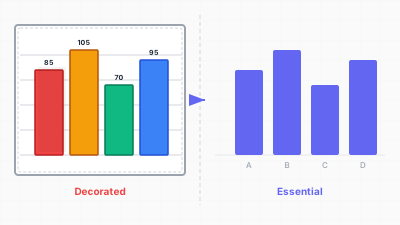
불필요한 요소를 제거하면 핵심 메시지가 더 명확해진다 / Removing unnecessary elements makes the core message clearer
핵심 아이디어 / Key Ideas
- 하나의 차트, 하나의 메시지: 각 시각화는 하나의 주요 인사이트를 전달해야 합니다. 3개의 인사이트가 있다면, 3개의 차트를 만드세요.
- One chart, one message: each visualization should communicate a single primary insight. If you have three insights, make three charts.
- 시리즈 수 줄이기: 하나의 차트에 4~5개 이상의 데이터 시리즈를 겹쳐 놓으면 스파게티가 됩니다. 시리즈 수를 줄이거나, 소형 다중(small multiples)으로 분리하세요.
- Reduce series count: overlaying more than 4–5 data series on a single chart produces spaghetti. Show fewer series, or use small multiples to separate them.
- 이중 y축 제거: 이중 y축은 디자이너가 스케일 조정으로 두 시리즈의 시각적 관계를 조작할 수 있게 합니다. 또한 관객이 어느 축이 어느 시리즈에 해당하는지 끊임없이 확인해야 합니다. 대신 두 개의 별도 차트를 사용하세요.
- Eliminate dual y-axes: dual y-axes allow the designer to manipulate the visual relationship between two series by adjusting scales. They also force the viewer to constantly check which axis applies to which series. Use two separate charts instead.
- 단순하게 시작, 필요에 따라 복잡성 추가: 가능한 가장 단순한 차트로 시작하세요. 특정 해석 작업이 요구할 때만 요소를 추가합니다. 인터랙티브 툴팁으로 정적 뷰를 어지럽히지 않고 세부 정보를 제공할 수 있습니다.
- Default to simplicity, add complexity on demand: start with the simplest possible chart. Add elements only when a specific interpretive task requires them. Interactive tooltips can provide detail without cluttering the static view.
- 3D 효과 제거: 2D 데이터의 3차원 렌더링(3D 바 차트, 3D 파이 차트)은 정보를 추가하지 않고, 원근 왜곡을 도입하며, 음영과 깊이 단서에 시각적 대역폭을 낭비합니다.
- Remove 3D effects: three-dimensional rendering of 2D data (3D bar charts, 3D pie charts) adds no information, introduces perspective distortion, and wastes visual bandwidth on shading and depth cues.
- 색상 사용 제한: 색상을 절제하고 목적 있게 사용하세요. 비필수 데이터 시리즈는 회색으로 처리하고, 관객이 집중해야 할 1~2개만 강조합니다.
- Limit color usage: use color sparingly and purposefully. Gray out non-essential data series and highlight only the one or two the viewer should focus on.
- 모든 장식 의심하기: 테두리, 배경, 그라데이션, 그림자, 아이콘, 로고 — 각각이 관객의 데이터 이해를 돕는지 물어보세요. 그렇지 않다면 제거합니다.
- Question every decoration: borders, backgrounds, gradient fills, shadows, icons, and logos — ask whether each one helps the viewer understand the data. If not, remove it.
좋은 예시 / Good Examples
- Knaflic의 "정리" 프로세스: Storytelling with Data에서 체계적 접근법을 보여줍니다 — Excel 기본 차트에서 시작하여, 테두리 제거, 격자선 축소, 범례 제거(직접 레이블로 대체), 색상 팔레트 단순화, 명확한 제목 추가. 전후 비교가 인상적입니다.
- Knaflic's "decluttering" process: in Storytelling with Data, she demonstrates a systematic approach — start with a default chart from Excel, then remove the border, reduce gridlines, remove the legend (replace with direct labels), simplify the color palette, and add a clear title. The before-and-after is striking.
- Bloomberg의 시장 차트: 깨끗한 화면 위의 단일 선, 핵심 이벤트를 표시하는 1~2개의 주석. 절제함이 데이터의 형태 자체를 말하게 합니다.
- Bloomberg's market charts: a single line on a clean field, with one or two annotations marking key events. The restraint lets the data shape speak for itself.
- "회색 + 한 가지 색" 기법: 내러티브가 집중하는 시리즈를 제외한 모든 데이터 시리즈를 회색으로 표시하고, 해당 시리즈만 강렬한 색으로 렌더링합니다. 관객의 시선이 즉시 강조된 시리즈로 향하고, 회색 맥락은 경쟁하지 않으면서 사용 가능합니다.
- The "gray + one color" technique: show all data series in gray except the one the narrative focuses on, which is rendered in a bold color. The viewer's eye is drawn to the highlighted series, and the gray context remains available without competing.
- 스파크라인: Tufte가 발명한 것으로, "절제의 미학"을 논리적 극단까지 밀어붙입니다 — 축, 레이블, 격자선 없이 단어 크기의 라인 차트. 맥락은 주변 텍스트가 제공합니다. 최소한의 시각적 요소로 데이터 패턴을 전달합니다.
- Sparklines: Edward Tufte's invention takes "less is more" to its logical extreme — a word-sized line chart with no axes, no labels, no gridlines. Context is provided by the surrounding text. The data pattern is communicated with the absolute minimum of visual elements.
안티 패턴 / Anti-Patterns
- "싱크대까지 넣은" 대시보드: 사용 가능한 모든 지표가 여러 차트 유형, 이중 축, 무지개 색상, 작은 글꼴로 단일 화면에 채워져 있습니다. 관객은 모든 것을 보지만 아무것도 이해하지 못합니다.
- The "kitchen sink" dashboard: every available metric crammed onto a single screen with multiple chart types, dual axes, rainbow colors, and tiny fonts. The viewer sees everything and understands nothing.
- 서로 다른 스케일의 이중 y축: 다른 범위의 축에 두 시리즈를 플로팅합니다. 선의 시각적 교차는 무의미합니다 — 임의적인 스케일 정렬의 부산물일 뿐입니다. 스케일 조정으로 한 시리즈가 다른 시리즈를 "능가"하는 것처럼 보이게 만들 수 있습니다.
- Dual y-axes with different scales: two series plotted on axes with different ranges. The visual intersection of the lines is meaningless — it is an artifact of the arbitrary scale alignment. One series can be made to appear to "surpass" the other by adjusting the scales.
- 폭발 효과의 3D 파이 차트: 3D 원근으로 렌더링되고 하나의 조각이 "폭발"된 파이 차트. 원근 왜곡으로 조각 크기 비교가 불가능하고, 폭발이 중요성과 무관하게 한 조각에 과도한 주의를 끕니다.
- 3D pie charts with explosion: a pie chart rendered in 3D perspective with one slice "exploded" out. The perspective distortion makes slice sizes impossible to compare, and the explosion draws disproportionate attention to one slice regardless of its importance.
- 장식적 인포그래픽: 데이터가 아트워크에 종속된 그림 속 차트. 관객은 디자인을 감상하지만 데이터를 추출할 수 없습니다.
- Decorative infographics: charts embedded in illustrations where the data is secondary to the artwork. The viewer admires the design but cannot extract the data.
- 인터랙티비티 남용: 정적 이미지가 더 명확한 차트에 호버 효과, 클릭 필터, 줌, 패닝, 애니메이션을 추가합니다. 인터랙티비티는 문제(정적 뷰에 너무 많은 데이터)를 해결해야지, 기술적 능력을 시연해서는 안 됩니다.
- Overuse of interactivity: adding hover effects, click-to-filter, zoom, pan, and animation to a chart that would be clearer as a static image. Interactivity should solve a problem (too much data for a static view), not demonstrate technical capability.
- 이중 인코딩 바 차트: 높이로 값을 인코딩하고, 색상 그라데이션으로도 값을 인코딩하고, 위에 숫자 레이블로도 값을 인코딩합니다. 세 개의 채널, 하나의 숫자.
- The double-encoded bar chart: bars with heights encoding the value, a color gradient also encoding the value, and a numeric label on top also encoding the value. Three channels, one number.
더 읽어보기 / Further Reading
- Tufte, E. R. (1983). The Visual Display of Quantitative Information. Graphics Press.
- Few, S. (2012). Show Me the Numbers (2nd ed.). Analytics Press.
- Knaflic, C. N. (2015). Storytelling with Data. Wiley.
- Maeda, J. (2006). The Laws of Simplicity. MIT Press.
- Saint-Exupery, A. de (1943). Le Petit Prince. Reynal & Hitchcock.