설명 / Description
그리드는 시각화의 구조적 골격입니다. 행, 열, 여백으로 이루어진 보이지 않는 비계(scaffold)를 세워 차트 영역 자체부터 제목, 범례, 주석, 출처 표기까지 모든 요소의 배치를 결정합니다. 그리드가 있으면 모든 요소가 공유된 공간 논리에 맞춰 정렬되어 결과물이 체계적이고 신뢰할 수 있으며 읽기 쉽게 느껴집니다. 그리드가 없으면 요소들이 임의 위치에 떠다니고, 시청자는 데이터를 읽기도 전에 공간적 관계를 파악하는 데 인지 에너지를 소모합니다.
정렬은 그리드의 실행 메커니즘입니다. 모든 텍스트 블록, 축, 차트 가장자리, 주석은 최소한 다른 하나의 요소와 정렬되어야 합니다. 공유된 정렬은 눈이 따라가는 보이지 않는 선을 만들어 페이지 전체에 시각적 연속성을 확립합니다. 요제프 뮐러-브로크만(Josef Muller-Brockmann)의 Grid Systems in Graphic Design은 복잡하고 정보가 밀집된 레이아웃도 모든 요소가 일관된 정렬 시스템에 참여하면 탐색 가능해진다는 것을 보여주었습니다. 데이터 시각화에서 이는 두 가지 스케일에 적용됩니다: 매크로 그리드(여러 차트가 페이지나 대시보드에 배치되는 방식)와 마이크로 그리드(단일 차트 내 요소들의 정렬 — 축 레이블과 눈금, 범례 항목 간, 주석과 데이터 포인트).
그리드는 또한 시각화에서 가장 강력한 비교 기법인 공통 기준선을 가능하게 합니다. 두 막대 차트가 정렬된 x축을 공유하면 시청자는 공통 스케일에서의 위치를 비교하여 값을 판단할 수 있습니다 — 클리블랜드와 맥길(Cleveland & McGill)의 연구에 따르면 이는 인간이 수행할 수 있는 가장 정확한 그래픽 지각 판단입니다. 기준선, 축, 스케일의 비정렬은 대시보드 디자인에서 가장 흔하고 해로운 실수 중 하나입니다.
A grid is the structural skeleton of a visualization. It establishes an invisible scaffolding of rows, columns, and margins that governs where every element is placed — from the chart area itself to titles, legends, annotations, and source credits. When a grid is in place, every element snaps to a shared spatial logic, and the result feels organized, trustworthy, and easy to scan. When it is absent, elements float in arbitrary positions, and the viewer must expend cognitive effort just to figure out the spatial relationships before they can even begin to read the data.
Alignment is the grid's enforcement mechanism. Every text block, axis, chart edge, and annotation should align to at least one other element. Shared alignment creates invisible lines that the eye follows, establishing visual continuity across the page. Josef Muller-Brockmann's seminal Grid Systems in Graphic Design demonstrated that even complex, information-dense layouts become navigable when every element participates in a consistent alignment system. In data visualization, this applies at two scales: the macro grid (how multiple charts are arranged on a page or dashboard) and the micro grid (how elements within a single chart are aligned — axis labels to tick marks, legend entries to each other, annotations to data points).
The grid also enables the most powerful comparative technique in visualization: the common baseline. When two bar charts share an aligned x-axis, viewers can compare values by comparing position along a common scale — the most accurate perceptual judgment humans can make, according to Cleveland and McGill's foundational ranking of graphical perception tasks. Misalignment of baselines, axes, or scales is one of the most common and damaging mistakes in dashboard design.
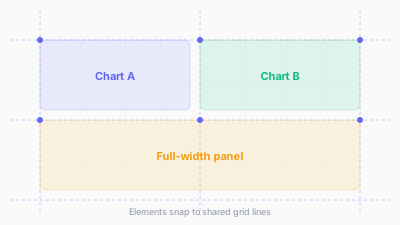
그리드 기반 레이아웃과 비정렬 레이아웃의 차이 / Grid-based layout vs. misaligned layout
핵심 아이디어 / Key Ideas
- 공통 기준선: 비교 대상 차트의 0선이나 시작점을 정렬하여 시청자가 길이가 아닌 위치 비교를 할 수 있게 합니다.
- Common baselines: align the zero line or starting point of compared charts so viewers can make positional (not just length) comparisons.
- 일관된 여백: 대시보드의 모든 차트에 동일한 패딩을 사용합니다. 비일관적 여백은 시각적 잡음을 만듭니다.
- Consistent margins: use the same padding around all charts in a dashboard. Inconsistent margins create visual noise.
- 열 기반 레이아웃: 대시보드와 다중 차트 페이지를 열 그리드(예: 12열)로 구성합니다. 차트, 텍스트 블록, 범례는 전체 또는 절반 열 너비여야 합니다.
- Column-based layouts: organize dashboards and multi-chart pages on a column grid (e.g., 12-column). Charts, text blocks, and legends should span full or half columns, not arbitrary widths.
- 스몰 멀티플에서의 축 정렬: 모든 패널이 동일한 축 범위와 위치를 공유해야 합니다. 한 패널의 y축이 0에서 시작하고 다른 패널이 50에서 시작하면 비교가 무효화됩니다.
- Axis alignment in small multiples: all panels must share the same axis ranges and positions. If one panel's y-axis starts at 0 and another at 50, comparison is sabotaged.
- 텍스트의 좌측 정렬: 제목, 부제목, 레이블을 공통 가장자리에 좌측 정렬합니다. 좌측 정렬 텍스트는 레이아웃을 고정하는 강한 수직선을 만듭니다.
- Left alignment for text: titles, subtitles, and labels should left-align to a common edge. Left-aligned text creates a strong vertical line that anchors the layout.
- 구조로서의 여백: 그리드는 요소가 놓이는 곳뿐만 아니라 놓이지 않는 곳도 정의합니다. 요소 사이의 빈 공간(거터)은 요소 자체만큼 중요합니다.
- Whitespace as structure: the grid defines not only where elements go but where they do not. The empty space between elements (gutters) is as important as the elements themselves.
좋은 예시 / Good Examples
- 에드워드 터프티의 스몰 멀티플: 각 패널이 규칙적 그리드의 동일한 셀을 차지하며 공유 축과 일관된 간격을 갖습니다. 그리드 덕분에 비교가 수월해집니다.
- Edward Tufte's small multiples: each panel occupies an identical cell in a regular grid, with shared axes and consistent spacing. The grid makes comparison effortless.
- 파이낸셜 타임스 대시보드 스타일: 엄격한 열 그리드에 차트가 배치되며 상단 가장자리가 정렬되고, 색상 범례가 공유되며, 여백이 일관됩니다. 레이아웃 자체가 차트들의 관련성을 전달합니다.
- The Financial Times dashboard style: charts in a dashboard are arranged on a strict column grid with aligned top edges, shared color legends, and consistent margins. The layout itself communicates that the charts are related.
- 정렬된 막대 차트: 두 인구 분포(예: 인구 피라미드)를 보여줄 때 막대가 공유 중심선에서 확장되어 직접 비교가 가능합니다.
- Aligned bar charts: when showing two demographic distributions (e.g., population pyramids), the bars extend from a shared center line, enabling direct comparison.
- 히트맵은 본질적으로 그리드 기반입니다: 행-열 구조가 곧 그리드이며, 셀의 완벽한 정렬이 패턴을 읽을 수 있게 합니다.
- Heatmaps are inherently grid-based: the row-column structure is the grid, and perfect alignment of cells is what makes the pattern readable.
안티 패턴 / Anti-Patterns
- 정렬 관계 없이 대시보드에 임의 위치로 배치된 떠다니는 차트. 시청자가 각 차트를 독립적으로 찾아야 합니다.
- Floating charts placed at arbitrary positions on a dashboard with no alignment relationship. The viewer has to hunt for each chart independently.
- 비교를 유도하는 나란한 차트에서 불일치하는 y축 범위. 한 차트의 y축이 0~100이고 인접 차트가 0~1,000이면 시각적 비교가 무의미합니다.
- Mismatched y-axis ranges in side-by-side charts that invite comparison. If one chart's y-axis runs 0–100 and the adjacent chart runs 0–1000, the visual comparison is meaningless.
- 모든 것을 중앙 정렬: 중앙 정렬은 제목에는 효과적이지만 목록, 레이블, 여러 줄 텍스트에서는 들쭉날쭉하고 약한 정렬을 만듭니다. 레이아웃이 고정되지 않은 느낌을 줍니다.
- Center-aligned everything: centering works for titles but creates ragged, weak alignment for lists, labels, and multi-line text. It also makes the layout feel unanchored.
- 스몰 멀티플에서 불균등한 패널 크기: 한 패널이 나머지보다 넓으면 그 패널의 데이터가 더 중요하다는 암시를 주는데, 이는 크기 차이가 우연인 경우에도 마찬가지입니다.
- Unequal panel sizes in small multiples: if one panel is wider than the rest, it implies that panel's data is more important, even when the size difference is accidental.
- 비일관적으로 배치된 범례: 범례가 한 차트 위, 다른 차트 오른쪽, 세 번째 차트 안에 위치하면 시청자가 매번 범례를 찾느라 시간을 낭비합니다.
- Legends placed inconsistently: the legend appears above one chart, to the right of another, and inside a third. The viewer wastes time finding the legend each time.
더 읽어보기 / Further Reading
- Muller-Brockmann, J. (1981). Grid Systems in Graphic Design. Verlag Niggli.
- Munzner, T. (2014). Visualization Analysis and Design. CRC Press.
- Tufte, E. R. (1990). Envisioning Information. Graphics Press.
- Cleveland, W. S., & McGill, R. (1984). Graphical Perception: Theory, Experimentation, and Application to the Development of Graphical Methods. Journal of the American Statistical Association, 79(387), 531–554.