설명 / Description
게슈탈트 원리는 20세기 초 막스 베르트하이머(Max Wertheimer)와 베를린 실험심리학파가 처음 정립한 이론으로, 인간의 시각 체계가 개별 요소들을 어떻게 자발적으로 구조화된 의미 있는 전체로 조직하는지를 설명합니다. 독일어 Gestalt는 "형태" 또는 "모양"을 뜻하며, 핵심 명제는 지각이 단순히 부분의 합이 아니라는 것입니다 — 우리는 개별 표시보다 패턴, 그룹, 구조를 먼저 인식합니다.
데이터 시각화에서 이 원리들은 선택적 스타일 가이드라인이 아니라 인간 지각의 근본적 제약 조건입니다. 여러분이 만드는 모든 차트는 이 규칙에 따라 시청자의 시각 피질에서 처리됩니다. 시각화가 게슈탈트 원리에 부합하면 시청자는 의도된 구조를 쉽게 인식하고, 위반하면 그룹을 잘못 읽거나 관계를 놓치거나 차트 해독에 어려움을 겪습니다.
시각화와 가장 관련 깊은 여섯 가지 게슈탈트 원리는 다음과 같습니다: 근접성(가까운 요소는 하나의 그룹으로 인식), 유사성(색상·형태·크기 등 시각적 속성이 같은 요소는 그룹화), 연속성(눈은 매끄러운 경로를 따름), 폐합(불완전한 형태를 완성하여 인식), 둘러싸기(경계선이 그룹을 형성), 연결성(요소를 잇는 선이 가장 강력한 그룹화 수단). 콜린 웨어(Colin Ware)의 연구에 따르면, 연결성과 둘러싸기는 정보 시각화에서 특히 강력하며 근접성과 유사성을 종종 압도합니다.
The Gestalt principles, first articulated by Max Wertheimer and the Berlin School of experimental psychology in the early 20th century, describe how the human visual system spontaneously organizes individual elements into structured, meaningful wholes. The German word Gestalt means "form" or "shape," and the central thesis is that perception is not simply the sum of its parts — we see patterns, groups, and structures before we see individual marks.
For data visualization, these principles are not optional stylistic guidelines but fundamental constraints of human perception. Every chart you create is parsed by a viewer's visual cortex according to these rules, whether you design for them or not. When a visualization aligns with Gestalt principles, viewers effortlessly perceive the intended structure. When it violates them, viewers misread groupings, miss relationships, or struggle to decode the chart at all.
The six most relevant Gestalt principles for visualization are: proximity (elements near each other are perceived as a group), similarity (elements sharing visual properties — color, shape, size — are grouped), continuity (the eye follows smooth paths), closure (the mind completes incomplete shapes), enclosure (boundaries create groups), and connection (lines linking elements create the strongest grouping of all). Colin Ware's research established that connectedness and enclosure are particularly powerful in information visualization contexts, often overriding proximity and similarity.
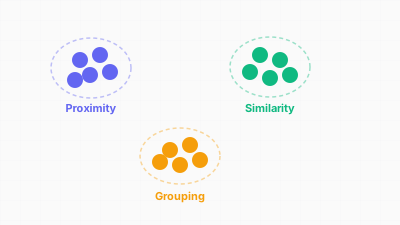
게슈탈트 원리: 근접성, 유사성, 연속성, 폐합, 둘러싸기, 연결성 / Gestalt principles: proximity, similarity, continuity, closure, enclosure, connection
핵심 아이디어 / Key Ideas
- 근접성(Proximity): 위치는 가장 자연스러운 그룹화 단서입니다. 가까이 배치된 요소는 같은 그룹으로 인식됩니다. 막대 차트에서 그룹 간 간격과 그룹 내 간격의 차이가 즉시 계층 구조를 전달합니다.
- Proximity: Position is the most natural grouping cue. Elements placed close together are perceived as belonging together. In bar charts, the spacing between groups of bars vs. within groups instantly communicates hierarchy.
- 유사성(Similarity): 색상, 형태, 크기가 범주적 그룹을 형성합니다. 범주별로 색상이 지정된 산점도는 명시적 경계 없이도 군집을 인식하게 합니다.
- Similarity: Color, shape, and size create categorical groupings. A scatterplot with points colored by category leverages similarity to let viewers see clusters without explicit boundaries.
- 연속성(Continuity): 눈은 매끄럽고 연속적인 경로를 따르려 합니다. 꺾은선 그래프는 이 원리를 활용하여 개별 데이터 포인트가 멀리 떨어져 있어도 하나의 데이터 시리즈로 인식되게 합니다.
- Continuity: The eye prefers to follow smooth, continuous paths. Line graphs exploit this principle — the continuous path of a line is perceived as a single data series even when individual data points are far apart.
- 폐합(Closure): 시각 체계는 불완전한 형태를 완성합니다. 차트의 격자선이 완전한 상자를 형성할 필요 없이, 몇 개의 기준선만으로도 좌표 공간을 인식할 수 있습니다.
- Closure: The visual system completes incomplete shapes. Grid lines in a chart do not need to form a full box; a few reference lines are enough for the viewer to perceive the coordinate space.
- 둘러싸기(Enclosure): 요소 주위에 경계를 그리면 근접성만으로는 얻을 수 없는 강력한 그룹화가 생깁니다. 스몰 멀티플의 음영 영역이나 주석 차트의 하이라이트 영역이 이에 해당합니다.
- Enclosure: Drawing a boundary around elements groups them more strongly than proximity alone. Shaded regions in small multiples or highlighted areas in annotated charts use enclosure.
- 연결성(Connection): 요소를 잇는 선이나 엣지는 가장 강력한 지각적 그룹화를 형성합니다. 네트워크 다이어그램과 연결 브러싱이 관계 전달에 효과적인 이유입니다.
- Connection: Lines or edges connecting elements create the strongest perceptual grouping. This is why network diagrams and linked brushing are so effective at communicating relationships.
좋은 예시 / Good Examples
- 그룹화된 막대 차트는 근접성을 활용하여 범주를 구분하면서 하위 범주를 시각적으로 연결합니다. 그룹 간 간격이 그룹 내 막대 간 간격보다 넓습니다.
- Grouped bar charts use proximity to separate categories while keeping sub-categories visually linked. The gap between groups is wider than the gap between bars within a group.
- 색상 코드 산점도는 유사성에 의존합니다. 색조가 일관되고 구별되면 명시적 레이블 없이도 군집을 즉시 인식합니다.
- Scatterplots with color-coded categories rely on similarity. When hue is consistent and distinct, viewers instantly perceive clusters even without explicit labels.
- 꺾은선 그래프는 연속성의 직접적 응용입니다 — 시청자의 눈이 x축을 따라 각 선을 하나의 개체로 추적하여 추세 비교가 가능합니다.
- Line graphs are a direct application of continuity — the viewer's eye tracks each line as a single entity across the x-axis, enabling comparison of trends.
- 스몰 멀티플은 둘러싸기(각 패널의 프레임)와 유사성(일관된 축, 스케일, 시각적 인코딩)을 결합하여 강력한 비교 구조를 만듭니다.
- Small multiples use enclosure (each panel's frame) and similarity (consistent axes, scales, and visual encoding) to create a powerful comparative structure.
안티 패턴 / Anti-Patterns
- 막대 차트의 비일관적 간격: 그룹 간 간격과 그룹 내 간격이 동일하면 근접성 단서가 파괴되어 어떤 막대가 함께 속하는지 알 수 없습니다.
- Inconsistent spacing in bar charts where gaps between groups and within groups are identical, destroying the proximity cue and making it impossible to tell which bars belong together.
- 산점도에 너무 많은 색상(7~8개 이상의 색조) — 시청자가 범주 매핑을 신뢰성 있게 구분하거나 기억할 수 없어 유사성이 무너집니다.
- Too many colors in a scatterplot (more than 7–8 hues) — similarity breaks down because the viewer cannot reliably distinguish or remember the categorical mappings.
- 끊어진 꺾은선 그래프: 결측 데이터를 표시하지 않고 시간 간격을 건너뛰어 데이터 포인트를 연결하면, 연속성 원리 때문에 시청자가 존재하지 않는 값을 보간합니다.
- Broken line graphs that connect data points across gaps in time without indicating missing data. The continuity principle causes viewers to interpolate values that do not exist.
- 둘러싸기의 과용 — 모든 요소를 두꺼운 테두리로 감싸면 시각적 잡음이 생기고, 테두리가 제공하려던 그룹화 자체를 약화시킵니다.
- Overuse of enclosure — boxing every element with heavy borders creates visual noise and undermines the very grouping the borders were meant to provide.
- 공간적 그룹화 없는 네트워크 다이어그램 — 연결된 노드가 무작위로 흩어지면 연결성 단서와 근접성 단서가 충돌하여 혼란스러운 "실타래"가 됩니다.
- Network diagrams without spatial grouping — if connected nodes are scattered randomly, the connection cue fights the proximity cue, producing a confusing "hairball."
더 읽어보기 / Further Reading
- Wertheimer, M. (1923). Untersuchungen zur Lehre von der Gestalt II. Psychologische Forschung, 4(1), 301–350.
- Ware, C. (2012). Information Visualization: Perception for Design (3rd ed.). Morgan Kaufmann.
- Few, S. (2009). Now You See It: Simple Visualization Techniques for Quantitative Analysis. Analytics Press.
- Palmer, S. E. (1999). Vision Science: Photons to Phenomenology. MIT Press.