설명 / Description
데이터-잉크 비율은 에드워드 터프티(Edward Tufte)가 데이터 시각화 문법에 기여한 가장 영향력 있는 개념입니다. 1983년 The Visual Display of Quantitative Information에서 소개된 이 개념은 겉보기에 단순합니다: 인쇄된 차트의 모든 잉크(또는 화면의 모든 픽셀) 중 실제 데이터를 나타내는 데 사용된 비율은 얼마인가? 터프티의 처방은 이 비율을 극대화하는 것입니다 — 정보를 직접 전달하지 않는 모든 것을 지우면, 남은 차트는 더 명확하고 정직하며 기억에 남게 됩니다.
공식은 간단합니다: 데이터-잉크 비율 = 데이터 잉크 / 그래픽에 사용된 총 잉크. 터프티는 일반적인 차트에서 잉크의 상당 부분 — 두꺼운 격자선, 중복 축 레이블, 장식적 채우기, 3D 효과, 배경 음영 — 이 정보적 가치를 전달하지 않는다고 주장합니다. 이러한 "차트정크(chartjunk)"는 통찰 없이 시청자의 인지 자원을 소모합니다. 비데이터 잉크를 체계적으로 제거하면 모든 시각적 요소가 자신의 존재를 정당화해야 합니다.
이 원칙은 단순한 미적 미니멀리즘이 아닙니다. 커뮤니케이션 이론의 핵심 통찰에 근거합니다: 잡음은 신호를 저하시킵니다. 모든 장식적 요소는 데이터 자체와 시청자의 주의를 놓고 경쟁합니다. 비데이터 잉크가 줄어들면 패턴, 이상치, 추세가 더 잘 보이고, 시청자는 더 빠르게 정확한 결론에 도달합니다. 다만 판단력 있게 적용해야 합니다 — 일부 비데이터 잉크(축 레이블, 기준선 하나, 제목)는 해석에 필수적이며, 목표는 비데이터 잉크를 0으로 만드는 것이 아니라 정보 전달에도 방향 안내에도 기여하지 않는 잉크를 제거하는 것입니다.
The data-ink ratio is Edward Tufte's most influential contribution to the grammar of data visualization. Introduced in The Visual Display of Quantitative Information (1983), the concept is deceptively simple: of all the ink on a printed chart (or pixels on a screen), what fraction is devoted to representing actual data? Tufte's prescription is to maximize this ratio — erase everything that does not directly convey information, and the remaining chart will be clearer, more honest, and more memorable.
The formula is straightforward: Data-Ink Ratio = Data Ink / Total Ink Used in the Graphic. Tufte argues that a large share of ink in typical charts — heavy grid lines, redundant axis labels, decorative fills, 3D effects, background shading — carries no informational value. This "chartjunk" (his term) taxes the viewer's cognitive resources without adding insight. By systematically removing non-data ink, the designer forces every visual element to justify its existence.
The principle is not merely aesthetic minimalism. It is rooted in a communication theory insight: noise degrades signal. Every decorative element competes for the viewer's attention with the data itself. When non-data ink is reduced, patterns, outliers, and trends become more visible, and the viewer reaches accurate conclusions faster. However, the principle should be applied with judgment — some non-data ink (axis labels, a single reference line, a title) is essential for interpretation. The goal is not zero non-data ink, but the elimination of ink that neither informs nor orients.
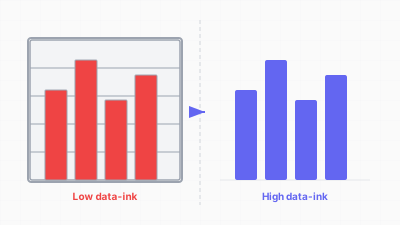
높은 데이터-잉크 비율(왼쪽)과 낮은 데이터-잉크 비율(오른쪽) 비교 / High data-ink ratio (left) vs. low data-ink ratio (right)
핵심 아이디어 / Key Ideas
- 데이터 잉크는 데이터 값을 나타내는 모든 표시입니다 — 막대의 높이, 점의 위치, 선의 기울기. 이를 제거하면 데이터가 사라집니다.
- Data ink is any mark on the chart that represents a data value — a bar's height, a point's position, a line's slope. Remove it and you lose data.
- 비데이터 잉크에는 격자선, 축 눈금, 테두리, 채우기, 범례(부분적), 장식이 포함됩니다. 일부는 방향 설정에 필요하지만 많은 부분은 불필요합니다.
- Non-data ink includes grid lines, axis ticks, borders, fills, legends (partially), and decorations. Some of it is necessary for orientation; much of it is not.
- **차트정크(Chartjunk)**는 정보적 목적이 없는 비데이터 잉크에 대한 터프티의 용어입니다: 3D 돌출, 그라데이션 채우기, 무아레 패턴, 클립아트, 두꺼운 테두리.
- Chartjunk is Tufte's term for non-data ink that serves no informational purpose: 3D extrusions, gradient fills, moiré patterns, clip art, and heavy borders.
- 중복 데이터 잉크는 동일한 정보를 두 번 인코딩하는 데이터 잉크입니다. 막대 높이와 숫자 레이블을 모두 가진 막대 차트는 중복이며, 둘 중 하나를 제거할 수 있습니다.
- Redundant data ink is data ink that encodes the same information twice. A bar chart with both a bar height and a numeric label on each bar is redundant — one of the two could be removed.
- 이 원칙은 법칙이 아닌 지침입니다. 맥락에 따라 비데이터 잉크의 필요량이 결정됩니다. 일반 대중을 위한 프레젠테이션 슬라이드는 연구 논문의 그림보다 더 많은 보조 잉크가 필요할 수 있습니다.
- The principle is a guideline, not a law. Context determines how much non-data ink is needed. A presentation slide for a lay audience may need more supporting ink than a research figure.
좋은 예시 / Good Examples
- **터프티의 재설계 상자 그림(box plot)**은 전통적 상자를 벗겨내고 범위를 나타내는 가는 선과 중앙값의 점으로 대체합니다 — 훨씬 적은 잉크로 동일한 5수 요약치를 전달합니다.
- Tufte's redesigned box plot strips away the traditional box, replacing it with a thin line for the range and a dot for the median — the same five-number summary with far less ink.
- **스파크라인(Sparklines)**은 최고의 고 데이터-잉크 비율 장치입니다: 축, 레이블, 격자선 없이 텍스트에 삽입되는 작은 꺾은선 그래프로, 순수한 데이터 잉크입니다.
- Sparklines are the ultimate high data-ink-ratio device: tiny word-sized line graphs embedded in text, with no axes, labels, or gridlines — pure data ink.
- 막대 차트를 대체하는 점 그래프(dot plots): 데이터 값 위치의 단일 점이 채워진 막대만큼 효과적으로 위치를 전달하면서 잉크는 극히 일부만 사용합니다.
- Dot plots replacing bar charts: a single dot at the data value communicates position just as effectively as a filled bar, using a fraction of the ink.
- 두꺼운 검은 격자 대신 옅은 회색 격자선(또는 격자선 없음). 강한 색상의 데이터 시리즈가 시각적 위계를 지배합니다.
- Light gray grid lines (or no grid lines at all) in place of heavy black grids. The data series, rendered in strong color, dominates the visual hierarchy.
- 월스트리트 저널 스타일: 최소한의 축, 가벼운 기준선, 범례 대신 직접 레이블링. 데이터-잉크 비율은 금융 데이터 저널리즘의 핵심 원칙입니다.
- The Wall Street Journal style: minimal axes, light reference lines, direct labeling instead of legends. Data-ink ratio is a core principle of financial data journalism.
안티 패턴 / Anti-Patterns
- 3D 막대 차트와 파이 차트 — 3차원은 데이터를 추가하지 않으면서 막대한 양의 잉크를 소비하고, 원근 왜곡으로 적극적으로 오도합니다.
- 3D bar charts and pie charts — the third dimension adds no data but consumes enormous amounts of ink and introduces perspective distortion that actively misleads.
- 데이터 선과 동일한 굵기로 모든 눈금마다 그려진 두꺼운 격자선. 격자가 데이터와 시각적 우위를 놓고 경쟁합니다.
- Heavy grid lines at every tick mark, drawn in the same weight as the data lines. The grid competes with the data for visual prominence.
- 막대나 영역 내부의 그라데이션 채우기와 장식적 텍스처. 이러한 패턴은 눈을 피로하게 하는 시각적 진동(무아레)을 생성하고 데이터 경계를 가립니다.
- Gradient fills and decorative textures inside bars or areas. These patterns create visual vibration (moiré) that fatigues the eye and obscures the data boundary.
- 중복 인코딩 — 막대 색상, 막대 높이, 숫자 레이블이 모두 같은 값을 인코딩하는 막대 차트. 시청자는 세 채널을 처리하지만 정보는 하나만 얻습니다.
- Redundant encoding — a bar chart where bar color, bar height, and a numeric label all encode the same value. The viewer processes three channels but gains only one piece of information.
- 과도한 눈금과 레이블 — 100개 데이터 포인트 x축에서 10번째마다 충분한데 모든 포인트에 레이블을 붙이는 경우.
- Excessive tick marks and labels on axes — labeling every single data point on a 100-point x-axis when every 10th would suffice.
더 읽어보기 / Further Reading
- Tufte, E. R. (1983). The Visual Display of Quantitative Information. Graphics Press.
- Tufte, E. R. (1990). Envisioning Information. Graphics Press.
- Few, S. (2012). Show Me the Numbers: Designing Tables and Graphs to Enlighten (2nd ed.). Analytics Press.
- Bateman, S., et al. (2010). Useful Junk? The Effects of Visual Embellishment on Comprehension and Memorability of Charts. Proc. CHI 2010. (A counterpoint: embellishment can improve recall.)