설명 / Description
색상은 데이터 시각화에서 가장 강력하면서 동시에 가장 오용되는 시각 채널입니다. 범주적 소속을 인코딩하고, 양적 크기를 표현하며, 핵심 요소에 주의를 끌고, 감정적 반응을 유발할 수 있습니다 — 하지만 절제 있게 적용할 때만 가능합니다. 잘못된 색상 선택은 색각이상자(남성의 8%)가 읽을 수 없거나, 암시된 크기가 오도하거나, 단순히 보기 좋지 않아 데이터에 대한 신뢰를 해치는 차트를 만들어냅니다.
시각화에서 효과적인 색상 사용은 세 가지 기둥에 기반합니다. 첫째, 색상 스케일과 데이터 유형의 일치: 범주형 데이터는 뚜렷한 색조의 정성적 팔레트를, 순차 데이터는 밝은 것에서 어두운 것으로의 단일 색조 그라데이션을, 발산형 데이터는 중립적 중간점에서 만나는 이중 색조 팔레트를 요구합니다. 신시아 브루어(Cynthia Brewer)의 ColorBrewer 팔레트가 이 세 가지 용도의 황금 표준입니다. 둘째, 지각적 균일성: 데이터의 동일한 단계는 인지된 색상 차이의 동일한 단계를 생성해야 합니다. 인간의 시각 체계는 RGB나 HSL을 선형적으로 인지하지 않으며, CIELAB과 HCL 색 공간이 이를 보정하도록 설계되었습니다. 셋째, 접근성: 팔레트는 가장 흔한 색각이상, 특히 적록 색각이상(deuteranopia) 하에서도 구분 가능해야 합니다.
이러한 기술적 요구 사항 외에도 색상은 문화적·맥락적 의미를 지닙니다. 빨간색은 금융에서 "위험" 또는 "손실"을, 미국 선거 지도에서는 "공화당"을 의미합니다. 파란색은 온도 지도에서 "차가움", 정치에서 "민주당", 브랜딩에서 "기업"일 수 있습니다. 한국에서는 주식 시장에서 빨간색이 상승, 파란색이 하락을 나타내는데, 이는 서양과 반대입니다. 디자이너는 이러한 연상을 의식하고 의도적으로 활용하거나 의도치 않은 신호를 피해야 합니다.
Color is simultaneously the most powerful and most misused visual channel in data visualization. It can encode categorical membership, represent quantitative magnitude, draw attention to key elements, and evoke emotional responses — but only when applied with discipline. Poor color choices produce charts that are unreadable to colorblind viewers (8% of men), misleading in their implied magnitudes, or simply ugly enough to undermine trust in the underlying data.
Effective color use in visualization rests on three pillars. First, matching the color scale to the data type: categorical data demands a qualitative palette of distinct hues, sequential data requires a single-hue gradient from light to dark, and diverging data needs a two-hue palette that meets at a neutral midpoint. Cynthia Brewer's ColorBrewer palettes, born from decades of cartographic research, remain the gold standard for these three use cases. Second, perceptual uniformity: equal steps in data should produce equal steps in perceived color difference. The human visual system does not perceive RGB or HSL linearly; the CIELAB and HCL color spaces were designed to correct for this, and modern tools like the viridis family of palettes are built on perceptually uniform spaces. Third, accessibility: a palette must remain distinguishable under the most common forms of color vision deficiency, particularly deuteranopia (red-green confusion).
Beyond these technical requirements, color carries cultural and contextual meaning. Red means "danger" or "loss" in financial contexts and "Republican" in US election maps. Blue can mean "cold" in a temperature map, "Democratic" in politics, or "corporate" in branding. Designers must be conscious of these associations and either leverage them deliberately or avoid unintentional signals.
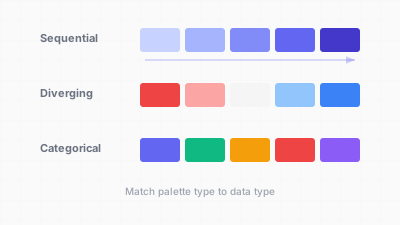
정성적, 순차적, 발산형 색상 팔레트 유형 비교 / Qualitative, sequential, and diverging color palette types
핵심 아이디어 / Key Ideas
- 정성적 팔레트(범주형): 명목 범주를 위한 5~8개의 최대 구분 색조. 8개 범주를 넘으면 더 많은 색상 대신 레이블이나 인터랙티브 필터링을 사용합니다.
- Qualitative palettes (categorical): 5–8 maximally distinct hues for nominal categories. Beyond 8 categories, use labels or interactive filtering instead of more colors.
- 순차적 팔레트: 밝기가 변하는 단일 색조(밝음 = 낮음, 어두움 = 높음). 인구 밀도나 온도 같은 연속 정량 데이터에 적합합니다.
- Sequential palettes: a single hue varying in lightness (light = low, dark = high). Works for continuous quantitative data like population density or temperature.
- 발산형 팔레트: 의미 있는 중간점에서 만나는 두 색조(예: 0에서의 편차를 나타내는 빨강-흰-파랑). 중간점 색상은 지각적으로 중립이어야 합니다.
- Diverging palettes: two hues meeting at a meaningful midpoint (e.g., red-white-blue for deviation from zero). The midpoint color must be perceptually neutral.
- 지각적 균일성: 무지개/jet 팔레트 대신 CIELAB/HCL 기반 팔레트(viridis, inferno, plasma, cividis)를 사용합니다. 무지개 팔레트는 지각적 사각지대와 인위적 경계가 있습니다.
- Perceptual uniformity: use CIELAB/HCL-based palettes (viridis, inferno, plasma, cividis) rather than rainbow/jet, which has perceptual dead zones and artificial boundaries.
- 색각이상 안전성: 유일한 구별 쌍으로 빨강-초록을 피합니다. 시뮬레이션 도구(Coblis, Sim Daltonism)로 팔레트를 테스트하고, 가능하면 중복 인코딩(형태 + 색상)을 사용합니다.
- Colorblind safety: avoid red-green as the sole distinguishing pair. Test palettes with simulation tools (Coblis, Sim Daltonism). Use redundant encoding (shape + color) when possible.
- 의미적 공명: 데이터 도메인에 맞는 자연적 연상(파란색 = 물, 초록 = 식물, 빨강 = 뜨거움)을 활용합니다.
- Semantic resonance: leverage natural associations (blue = water, green = vegetation, red = hot) when they match the data domain.
좋은 예시 / Good Examples
- 단계구분도(choropleth map)의 ColorBrewer 팔레트: 인구 밀도에 순차적 블루, 선거 마진에 발산형 적-청. 수십 년간 지도학 연구로 검증되었습니다.
- ColorBrewer palettes on choropleth maps: sequential blues for population density, diverging red-blue for election margins. Cartographic research has validated these for decades.
- 히트맵의 viridis 팔레트: 지각적으로 균일하고, 색각이상에 안전하며, 흑백 인쇄에서도 잘 보입니다. 실패하기 어려운 기본 선택입니다.
- The viridis palette on heatmaps: perceptually uniform, colorblind-safe, and prints well in grayscale. A default choice that is hard to get wrong.
- 빨강/초록을 사용하는 금융 차트에서 접근성을 위해 위/아래 화살표나 +/- 부호를 중복 인코딩으로 추가하는 사례.
- Financial charts using red/green (loss/gain) but adding up/down arrows or +/- signs as redundant encoding for accessibility.
- 색조와 형태를 모두 사용하여 범주를 인코딩하는 산점도: 파란 원, 주황 삼각형. 색상을 구별할 수 없더라도 형태는 구별됩니다.
- Scatterplots using both hue and shape to encode categories: circles in blue, triangles in orange. Even if a viewer cannot distinguish the colors, the shapes remain distinct.
안티 패턴 / Anti-Patterns
- 연속 데이터에 무지개(jet) 팔레트: 노란색과 청록색 띠가 데이터에 존재하지 않는 인위적 시각 경계를 생성합니다. 시각화 연구에서 가장 많이 비판받는 팔레트입니다.
- The rainbow (jet) palette on continuous data: the bands of yellow and cyan create artificial visual boundaries where none exist in the data. This is the single most criticized palette in visualization research.
- 중복 인코딩 없이 색상만을 유일한 구별 채널로 사용. 범례가 청록과 초록의 구별에 의존한다면 많은 시청자가 실패합니다.
- Using color as the only distinguishing channel without redundant encoding. If the legend depends on distinguishing teal from green, many viewers will fail.
- 너무 많은 범주 색상(10개 이상): 시청자가 7~8개 이상의 색조를 범주에 신뢰성 있게 매핑할 수 없습니다. 차트가 구별할 수 없는 색상의 무더기가 됩니다.
- Too many categorical colors (10+): viewers cannot reliably map more than 7–8 hues to categories. The chart becomes a confetti of indistinguishable colors.
- 뷰 간 비일관적 색상 매핑: "매출"이 한 차트에서 파란색이고 다음 차트에서 주황색이면, 시청자는 인코딩을 재학습하는 데 인지 노력을 낭비합니다.
- Inconsistent color mapping across views: if "revenue" is blue in one chart and orange in the next, viewers waste cognitive effort re-learning the encoding.
- 눈을 피로하게 하는 고채도 팔레트: 흰색 배경 위의 밝은 네온 색상이 진동하여 시청자를 피로하게 합니다. 큰 영역에는 탁하고 낮은 채도를, 작고 중요한 표시에는 높은 채도를 사용합니다.
- High-saturation palettes that cause eye fatigue: bright neon colors on white backgrounds vibrate and tire the viewer. Prefer muted, desaturated hues for large areas (backgrounds, fills) and reserve high saturation for small, high-importance marks.
더 읽어보기 / Further Reading
- Brewer, C. A. (2005). Designing Better Maps: A Guide for GIS Users. ESRI Press.
- Munzner, T. (2014). Visualization Analysis and Design. CRC Press.
- Stone, M. (2006). Choosing Colors for Data Visualization. Business Intelligence Network.
- Crameri, F., Shephard, G. E., & Heron, P. J. (2020). The misuse of colour in science communication. Nature Communications, 11(1), 5444.
- ColorBrewer 2.0: https://colorbrewer2.org/