설명 / Description
주석이 없는 차트는 질문이고, 주석이 있는 차트는 답변입니다. 주석은 디자이너가 차트에 추가하는 텍스트 레이블, 콜아웃 라인, 하이라이트 영역, 기준선, 마커로, 시청자의 주의를 유도하고 맥락을 제공하며 의도된 서사를 전달합니다. 주석이 없으면 시청자가 차트를 처음부터 해독하여 자신만의 (아마도 틀린) 해석을 형성해야 합니다. 잘 배치된 주석이 있으면 디자이너는 가장 중요한 통찰 — 차트가 존재하는 이유 — 이 즉시 전달되도록 보장할 수 있습니다.
주석의 힘은 구체성에 있습니다. 제목이 "3분기에 매출이 성장했다"고 말할 수 있지만, 꺾은선 그래프의 변곡점에 직접 배치된 "신제품 출시 — 8월 15일"이라는 주석은 데이터 패턴을 인과적 설명에 연결합니다. 이런 맥락적 주석이 시각화를 데이터 덤프에서 분석 작품으로 변환합니다. 뉴욕 타임스의 아만다 콕스(Amanda Cox)는 주석이 종종 차트에서 가장 중요한 부분이라고 주장하며, "주석 레이어는 우리가 하는 가장 중요한 일입니다... 그렇지 않으면 스토리가 아니라 도구에 불과합니다"라고 말했습니다.
효과적인 주석 디자인에는 절제가 필요합니다. 모든 데이터 포인트에 주석을 달면 통찰이 아닌 잡음이 됩니다. 디자이너는 데이터의 가장 중요한 1~3가지 특징 — 피크, 교차점, 구조적 단절, 이상치 — 을 선택하여 그것만 주석 처리해야 합니다. 각 주석은 데이터보다 시각적으로 부차적(더 작은 텍스트, 더 옅은 색, 더 가는 선)이어야 하며, 데이터 자체와 경쟁하지 않으면서 시선을 안내합니다. 주석은 외치는 헤드라인이 아니라 속삭이는 곁가지입니다.
An unannotated chart is a question. An annotated chart is an answer. Annotations are the text labels, callout lines, highlighted regions, reference lines, and markers that a designer adds to a chart to direct the viewer's attention, provide context, and convey the intended narrative. Without annotations, the viewer must decode the chart from scratch, forming their own (possibly incorrect) interpretation. With well-placed annotations, the designer can ensure that the most important insight — the reason the chart exists — is communicated immediately.
The power of annotation lies in its specificity. A title can say "Revenue grew in Q3," but an annotation placed directly at the inflection point of a line graph, reading "New product launch — Aug 15," connects the data pattern to a causal explanation. This kind of contextual annotation transforms a visualization from a data dump into a piece of analysis. Amanda Cox of The New York Times has argued that the annotations are often the most important part of a chart, saying "the annotation layer is the most important thing we do... otherwise it's a tool, not a story."
Effective annotation design requires restraint. Annotating every data point produces noise, not insight. The designer must choose the 1–3 most important features of the data — a peak, a crossover, a structural break, an outlier — and annotate only those. Each annotation should be visually subordinate to the data (smaller text, lighter color, thinner lines) so that it guides the eye without competing with the data itself. The annotation is a whispered aside, not a shouted headline.
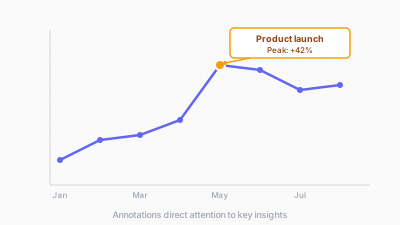
효과적인 주석: 핵심 이벤트에만 절제된 스타일로 맥락 제공 / Effective annotation: providing context with restrained styling on key events only
핵심 아이디어 / Key Ideas
- 범례보다 직접 레이블링: 데이터 마크에 직접 시리즈명을 배치합니다. 별도 범례 교차 참조의 인지 비용을 제거합니다.
- Direct labeling over legends: place series names directly on or adjacent to the data marks. This eliminates the cognitive cost of cross-referencing a separate legend.
- 맥락적 주석: 데이터 패턴을 설명하는 외부 이벤트(정책 변경, 제품 출시, 위기)를 표시합니다. 가는 지시선으로 주석 텍스트를 관련 데이터 포인트에 연결합니다.
- Contextual annotations: mark external events (policy changes, product launches, crises) that explain patterns in the data. Connect annotation text to the relevant data point with a thin leader line.
- 기준선: 의미 있는 임계값(목표, 평균, 규제 한계)의 수평 또는 수직선이 시청자에게 판단의 기준점을 제공합니다.
- Reference lines: horizontal or vertical lines at meaningful thresholds (targets, averages, regulation limits) give viewers an anchor for judgment.
- 하이라이트 영역: 음영 띠(예: 시계열의 경기 침체 기간)가 데이터 포인트를 추가하지 않고 시간적 맥락을 제공합니다.
- Highlighted regions: shaded bands (e.g., recession periods on a time series) provide temporal context without adding data points.
- 주석 위계: 주석은 데이터 마크보다 시각적으로 가볍지만 격자선보다는 무거워야 합니다. 데이터와 배경 사이의 중간 레이어에 존재합니다.
- Annotation hierarchy: annotations should be visually lighter than data marks but heavier than grid lines. They exist in a middle layer between the data and the background.
- 간결성: 주석 텍스트는 가능한 한 짧아야 합니다 — 문장이 아닌 구(phrase). 더 많은 설명이 필요하면 부제목이나 각주를 사용합니다.
- Brevity: annotation text should be as short as possible — a phrase, not a sentence. If more explanation is needed, use a subtitle or footnote.
좋은 예시 / Good Examples
- COVID-19 기간 뉴욕 타임스 꺾은선 그래프: 주요 날짜(봉쇄, 백신 승인)가 가는 수직선과 간결한 레이블로 표시되어 데이터 추세를 실제 이벤트에 고정시킵니다.
- The New York Times line charts during COVID-19: key dates (lockdowns, vaccine approvals) were marked with thin vertical lines and brief labels, anchoring the data trends in real-world events.
- 레이블된 이상치가 있는 산점도: GDP와 기대수명별 국가 산점도에서 추세를 벗어나는 주목할 만한 이상치만 레이블합니다. 대부분의 점은 레이블 없이 남아 명확성을 유지합니다.
- Scatterplots with labeled outliers: in a scatterplot of countries by GDP and life expectancy, only the notable outliers (e.g., outlier nations that defy the trend) are labeled. The bulk of points remain unlabeled, preserving clarity.
- 경기 침체 음영 띠가 있는 영역 차트: NBER 경기 침체 기간을 회색 띠로 표시하는 경제 시각화의 일반적 장치로, 데이터의 상승과 하락을 즉시 맥락화합니다.
- Area charts with shaded recession bands: a common device in economic visualization where gray bands indicate NBER recession periods, instantly contextualizing rises and falls in the data.
- "목표" 기준선이 있는 막대 차트: 목표값에 수평 점선이 있어 시청자가 즉시 어떤 막대가 목표를 초과하거나 미달하는지 볼 수 있습니다.
- Bar charts with a "target" reference line: a horizontal dashed line at the target value lets viewers instantly see which bars exceed or fall short of the goal.
안티 패턴 / Anti-Patterns
- 모든 데이터 포인트에 주석 달기: 50개 데이터 포인트 각각에 값이 레이블된 꺾은선 그래프. 주석이 겹치고 읽을 수 없게 되며 그것이 명확히 하려던 추세를 가립니다.
- Annotating every data point: a line graph with 50 data points, each labeled with its value. The annotations overlap, become illegible, and obscure the trend they were meant to clarify.
- 과도한 주석 스타일링: 두꺼운 테두리 상자 안의 볼드, 크고 어두운 주석 텍스트. 주석이 데이터를 시각적으로 압도하여 안내자 대신 초점이 됩니다.
- Heavy annotation styling: bold, large, dark annotation text in boxes with thick borders. The annotations visually overpower the data and become the focal point instead of a guide.
- 단절된 주석: 주석 텍스트가 그것이 설명하는 데이터에서 멀리 떨어져 있고, 지시선이나 시각적 연결이 없습니다. 시청자가 어떤 데이터 포인트를 가리키는지 판단할 수 없습니다.
- Disconnected annotations: annotation text placed far from the data it describes, with no leader line or visual connection. The viewer cannot determine which data point the annotation refers to.
- 모호한 기준선: 레이블 없는 수평선이 차트를 가로지릅니다. 평균인가? 중앙값인가? 목표인가? 규제 한계인가? 레이블 없는 기준선은 오해를 초대합니다.
- Ambiguous reference lines: a horizontal line across a chart with no label. Is it the mean? The median? A target? A regulation limit? Unlabeled reference lines invite misinterpretation.
- 명백한 것을 말하는 주석: 명확한 상승 추세에 "값이 증가했다"라고 레이블하기. 좋은 주석은 설명(증가했다는 것)이 아닌 맥락(왜 증가했는지)을 제공합니다.
- Annotations that state the obvious: labeling a clear upward trend with "values increased." Good annotations provide context (why it increased), not description (that it increased).
더 읽어보기 / Further Reading
- Schwabish, J. (2021). Better Data Visualizations. Columbia University Press.
- Kirk, A. (2019). Data Visualisation: A Handbook for Data Driven Design (2nd ed.). SAGE Publications.
- Knaflic, C. N. (2015). Storytelling with Data. Wiley.
- Rost, L. C. (2018). "What to consider when considering data vis annotations." Datawrapper Blog.