The Grammar of Graphics
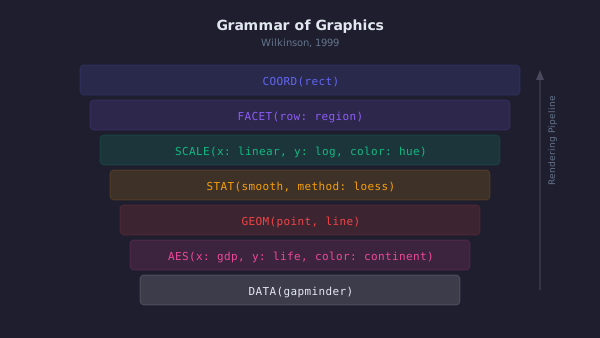
Historic리랜드 윌킨슨(Leland Wilkinson)이 1999년에 펴낸 《그래픽의 문법(The Grammar of Graphics)》은 오늘날 모든 현대 시각화 도구의 기저를 이루는 대수적 프레임워크를 제시했습니다. 윌킨슨은 차트를 막대, 선, 산점도 같은 고정된 유형으로 다루는 대신, 데이터, 변환, 스케일, 좌표, 기하(geometry), 미학(aesthetics) 등 조합 가능한 레이어로 분해했습니다.
Leland Wilkinson's 1999 The Grammar of Graphics provided the algebraic framework that underlies every modern visualization tool. Instead of treating charts as fixed types (bar, line, scatter), Wilkinson decomposed them into composable layers: data, transformations, scales, coordinates, geometries, and aesthetics.
이러한 문법적 접근에 따르면 "막대 차트"와 "누적 막대 차트"는 서로 다른 유형이 아니라, 같은 문법에 다른 매개변수를 적용한 것에 지나지 않습니다. 이 통찰은 대단히 생산적이었습니다: 이미 알려진 구성 요소들을 조합함으로써 새로운 차트 유형을 발견할 수 있게 해주었기 때문입니다.
This grammatical approach meant that a "bar chart" and a "stacked bar chart" weren't different types — they were the same grammar with different parameters. This insight was profoundly generative: it made new chart types discoverable by combining known components.
윌킨슨의 문법은 ggplot2(해들리 위컴(Hadley Wickham), 2005), Vega/Vega-Lite(제프리 히어(Jeffrey Heer), 2013-2016), 옵저버블 플롯(Observable Plot, 마이크 보스톡, 2021)에 직접적인 영감을 주었습니다. 오늘날 사용되는 거의 모든 선언형 시각화 도구는 이 책의 후예라 할 수 있습니다.
Wilkinson's grammar directly inspired ggplot2 (Hadley Wickham, 2005), Vega/Vega-Lite (Jeffrey Heer, 2013-2016), and Observable Plot (Mike Bostock, 2021). Nearly every declarative visualization tool used today is a descendant of this book.