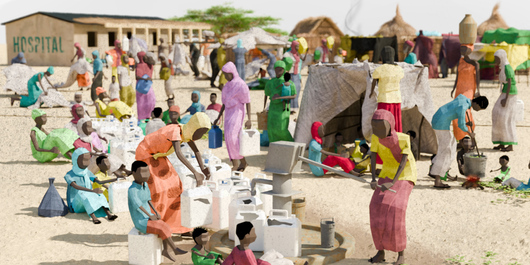
The world’s hunger watchdog warned of catastrophe in Sudan. Famine struck anyway.
금상Gold제도적 실패를 하나의 장소와 그곳 사람들의 이야기로 설명하는 방법을 보여줍니다.It shows how a system-level failure can be explained through one place and its people.
로이터(Reuters)의 이 탐사 보도는 클레어 팔리(Clare Farley), 마리아노 사프라(Mariano Zafra), 라이언 맥닐(Ryan McNeill) 등이 참여해 제작했으며, 수단의 잠잠(Zamzam) 난민 캠프를 다룹니다. 세계 기아 감시 체계가 재앙을 경고했는데도, 캠프가 기근으로 판정되기 전까지 몇 달 동안 아이들이 목숨을 잃었습니다.
This Reuters investigation, produced by a team led by Clare Farley, Mariano Zafra, Ryan McNeill and others, examines the Zamzam displaced persons camp in Sudan. Children there were dying for months before the camp was found to be in famine, even though the global hunger monitor had warned of catastrophe.
세계 기아 감시 및 대응 체계가 원래 어떻게 작동해야 하는지, 그리고 왜 그 임무를 달성하지 못했는지를 설명합니다. 제도 차원의 설명을 한 캠프의 이야기와 결합한 점에서, 과정을 풀어내는 데이터 저널리즘의 참고 사례가 됩니다.
The piece explains how the world's hunger monitoring-and-response system is supposed to work and why it fell short of its mission. It pairs this system-level explanation with a single camp's story, which is a useful model for data journalism that explains a process.
제작Credits
by Clare Farley, Mariano Zafra, Ryan McNeill, Maggie Michael, Lena Masri, Deborah Nelson and Raymon Troncoso
Additional graphics by Sam Hart and Anurag Rao
Additional reporting by Nafisa Eltahir, Khalid Abdelaziz, Jaimi Dowdell, Benjamin Lesser, Kaylee Kang, Steve Stecklow, Allison Martell and Charlie Szymanski
Edited by Feilding Cage, Janet Roberts and Peter Hirschberg