Napoleon's March to Moscow
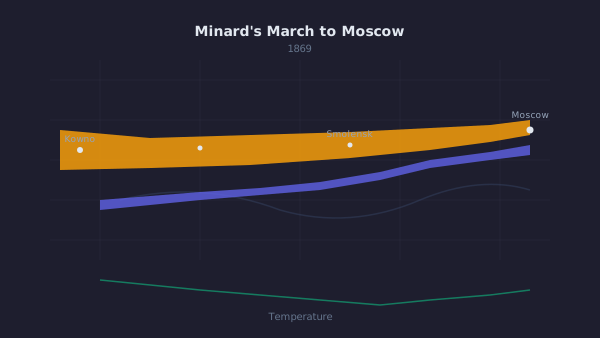
Historic역사상 가장 위대한 통계 그래픽으로 널리 평가받는 작품입니다. 샤를 조제프 미나르(Charles Joseph Minard)의 1869년 지도는 나폴레옹의 처참했던 1812년 러시아 원정을 추적하며, 하나의 이미지 안에 여섯 개의 변수를 인코딩합니다: 군대의 규모(띠의 너비), 위치(지리적 경로), 이동 방향(색상 — 진군은 황갈색, 퇴각은 검은색), 퇴각 중의 기온(하단의 눈금), 날짜, 지리적 좌표가 그것입니다.
Widely considered the greatest statistical graphic ever drawn. Minard's 1869 map traces Napoleon's catastrophic 1812 Russian campaign, encoding six variables in a single image: the army's size (width of the band), location (geographic path), direction of movement (color: tan for advance, black for retreat), temperature during the retreat (scale at bottom), dates, and geographic coordinates.
에드워드 터프티(Edward Tufte)는 《The Visual Display of Quantitative Information》에서 이 작품을 "지금까지 그려진 가장 훌륭한 통계 그래픽"일 것이라고 평했습니다. 이 그래픽은 단 한마디의 서술도 없이 참혹한 이야기를 전합니다 — 42만 2천 명이었던 군대는 단 1만 명의 생존자로 줄어들고, 퇴각 중 곤두박질치는 기온은 그 원인을 생생하게 드러냅니다.
Edward Tufte called it possibly "the best statistical graphic ever drawn" in The Visual Display of Quantitative Information. The graphic tells a devastating story without a single word of narrative — the army shrinks from 422,000 soldiers to just 10,000 survivors, and the plummeting temperatures on the retreat make the cause viscerally clear.
이 작품이 시대를 초월하는 이유는 우아한 단순함으로 달성한 정보 밀도에 있습니다. 불필요한 장식도, 차트 정크도 없이 — 모든 마크가 데이터를 인코딩합니다. 이는 오늘날에도 정적 이미지 안에서 다변량 스토리텔링을 구현하는 최고의 표준으로 남아 있습니다.
What makes it timeless is the information density achieved with elegant simplicity. No chart junk, no decoration — every mark encodes data. It remains the gold standard for multivariate storytelling in a static image.