Semiology of Graphics
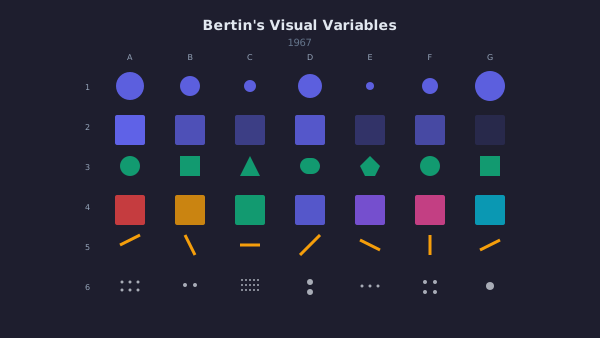
Historic자크 베르탱(Jacques Bertin)의 1967년 저작 《Sémiologie Graphique》는 현대 시각화 이론의 토대입니다. 이 책은 위치, 크기, 형태, 명도, 색상, 방향, 텍스처라는 "시각 변수"를 체계적으로 분류하고, 각 변수가 어떤 데이터 유형(명목형, 순서형, 양적)을 효과적으로 인코딩할 수 있는지를 설명했습니다.
Jacques Bertin's 1967 Sémiologie Graphique is the theoretical foundation of modern visualization. It systematically classified the "visual variables" — position, size, shape, value, color, orientation, and texture — and described which data types (nominal, ordinal, quantitative) each variable could effectively encode.
베르탱의 프레임워크는 디자이너들에게 어떤 차트가 다른 차트보다 더 효과적인 이유를 논할 수 있는 엄밀한 어휘를 제공했습니다. 그의 시각 변수는 윌킨슨(Wilkinson)의 Grammar of Graphics부터 Vega-Lite에 이르기까지, 오늘날 모든 현대 시각화 문법의 기초로 남아 있습니다.
Bertin's framework gave designers a rigorous vocabulary for discussing why one chart works better than another. His visual variables remain the basis of every modern visualization grammar, from Wilkinson's Grammar of Graphics to Vega-Lite.
이 책은 또한 "재배열 가능한 행렬(reorderable matrices)"이라는 개념을 개척했습니다 — 데이터 테이블의 행과 열을 재배치하면 패턴이 드러날 수 있다는 발상입니다. 이 개념은 순서 배열(seriation), 히트맵 클러스터링, 평행 좌표 재정렬 같은 현대적 기법의 기반이 되고 있습니다.
The book also pioneered the concept of "reorderable matrices" — the idea that rearranging rows and columns of a data table could reveal patterns. This concept underlies modern techniques like seriation, heatmap clustering, and parallel coordinates reordering.